There was a time when making a game with production values matching major studios required tens of millions of dollars, bespoke proprietary engines, and a team of hundreds of developers.
That era is officially over.
Today, the gap between a massive AA studio and a core team of three working out of a home office is narrower than it has ever been. Driven by fierce competition, rapid technical advances, and shifting licensing models across Unreal Engine, Godot, and Unity, modern game development tools are democratizing what small teams can achieve.
Here is a breakdown of how the big three game engines are reshaping the landscape for indie developers—and why the playing field has never been more level.
1. Unreal Engine: Bringing AAA Fidelity to Indie Budgets
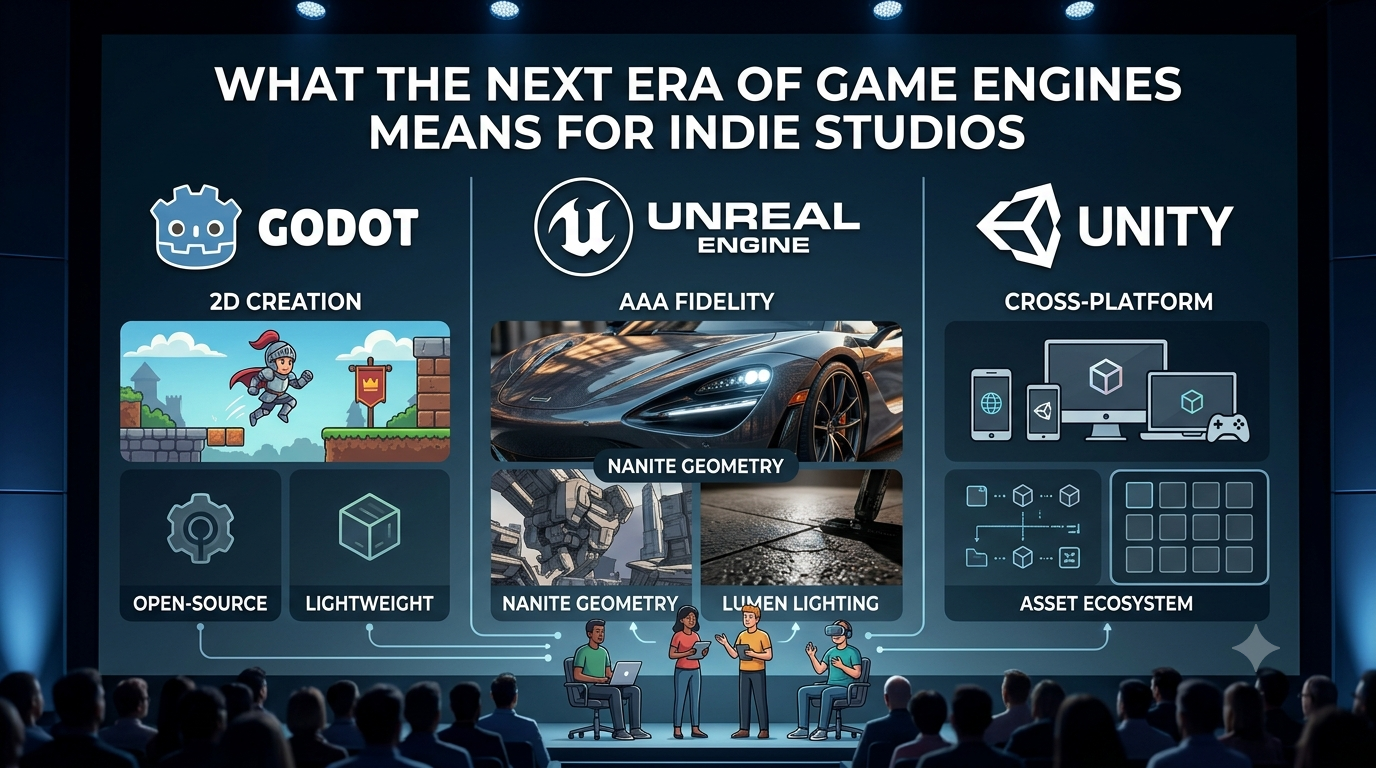
Unreal Engine 5 (UE5) transformed the perception of what small teams could build. Features that used to eat up months of technical art pipeline work are now automated natively in the engine:
- Nanite (Virtualized Geometry): Allows artists to import film-quality 3D assets directly into the engine without manually spending hundreds of hours creating Level of Detail (LOD) models.
- Lumen (Dynamic Global Illumination): Eliminates the need to spend weeks baking lightmaps, enabling real-time, dynamic lighting out of the box.
- Accessible Royalty Terms: Free to use until a title crosses $1 million in gross lifetime revenue—after which Epic takes a 5% royalty.
For indie developers targeting photorealistic visuals or ambitious 3D worlds, Unreal Engine allows a team of five to deliver fidelity that previously required fifty.
2. Godot: The Open-Source Revolution
If Unreal represents raw graphical horsepower, Godot represents independence and ultimate control. Expanding rapidly following recent engine license shakeups across the industry, Godot has grown into a formidable production engine:
- 100% Free & MIT-Licensed: Zero seat fees, zero subscription costs, and zero royalties forever.
- Ultra-Lightweight & Fast: The editor binary weighs under 100MB, launches instantly, and features hot-reloading for rapid scene iteration.
- Purpose-Built 2D & Modern 3D: Features a dedicated, ground-up 2D engine alongside an upgraded Vulkan-backed 3D renderer and native Jolt physics.
For solo developers, game jam enthusiasts, and small studios creating stylized 3D or intricate 2D titles, Godot offers complete ownership with zero platform risk.
3. Unity: Refined Tooling & Ecosystem Power
Despite turbulent market shifts in recent years, Unity remains a dominant powerhouse for cross-platform and mobile deployment. Its recent focus on stability, rendering upgrades, and developer trust has stabilized its position:
- Ecosystem Advantage: The Unity Asset Store remains unmatched, offering pre-built networking frameworks, UI tools, and shader packages that cut months off development timelines.
- Performance & Flexibility: Features like the Universal Render Pipeline (URP) and GPU Resident Drawer allow games to scale seamlessly from low-end mobile devices to high-performance desktop PCs.
- Predictable Pricing: Free up to $200,000 in annual revenue, transitioning to seat-based Pro licensing with zero revenue royalties.
Engine Breakdown at a Glance
| Feature / Criteria | Unreal Engine 5 | Godot 4 | Unity 6 |
| Best Suited For | High-end 3D, Photorealism, Cinematic titles | 2D games, Stylized 3D, Rapid prototyping | Cross-platform, Mobile, Systems-heavy games |
| Licensing Model | Free until $1M revenue; 5% royalty thereafter | 100% Free (MIT License, $0 forever) | Free under $200k funding/rev; seat license above |
| Key Advantage | Automated LODs (Nanite) & Lighting (Lumen) | Instant boot times, lightweight footprint, open-source | Massive asset store & multiplatform deployment |
| Primary Languages | C++ & Blueprint Visual Scripting | GDScript (Python-like), C#, C++ | C# |
The Takeaway: What This Means for Indie Studios
The evolution of modern game engines changes the fundamental economics of game development:
- Lower Overhead, Broader Ambition: Small studios no longer need to spend early venture capital or savings on tools and backend technology. Money can be directed toward game design, art, and marketing.
- Design Over Tech Debt: When illumination, asset optimization, and cross-platform builds are handled automatically by the engine, developers spend less time fighting pipelines and more time polishing mechanics.
- Diversified Engine Choices: Indie studios are no longer locked into a single ecosystem. A studio might build its stylized 2D roguelike in Godot, its mobile strategy game in Unity, and its immersive 3D horror title in Unreal Engine.
The technical barriers to entry have officially crumbled. In this new era, the deciding factor for an indie game’s success isn’t the size of its engineering team—it’s the strength of its core idea and execution.