Callouts are the short pieces of information teammates give each other during a match. Good callouts make an average team dangerous. Bad ones fill the channel with noise at the exact moment people need to listen. These five rules work in any game with voice chat.
Rule 1: Say what, where and how many
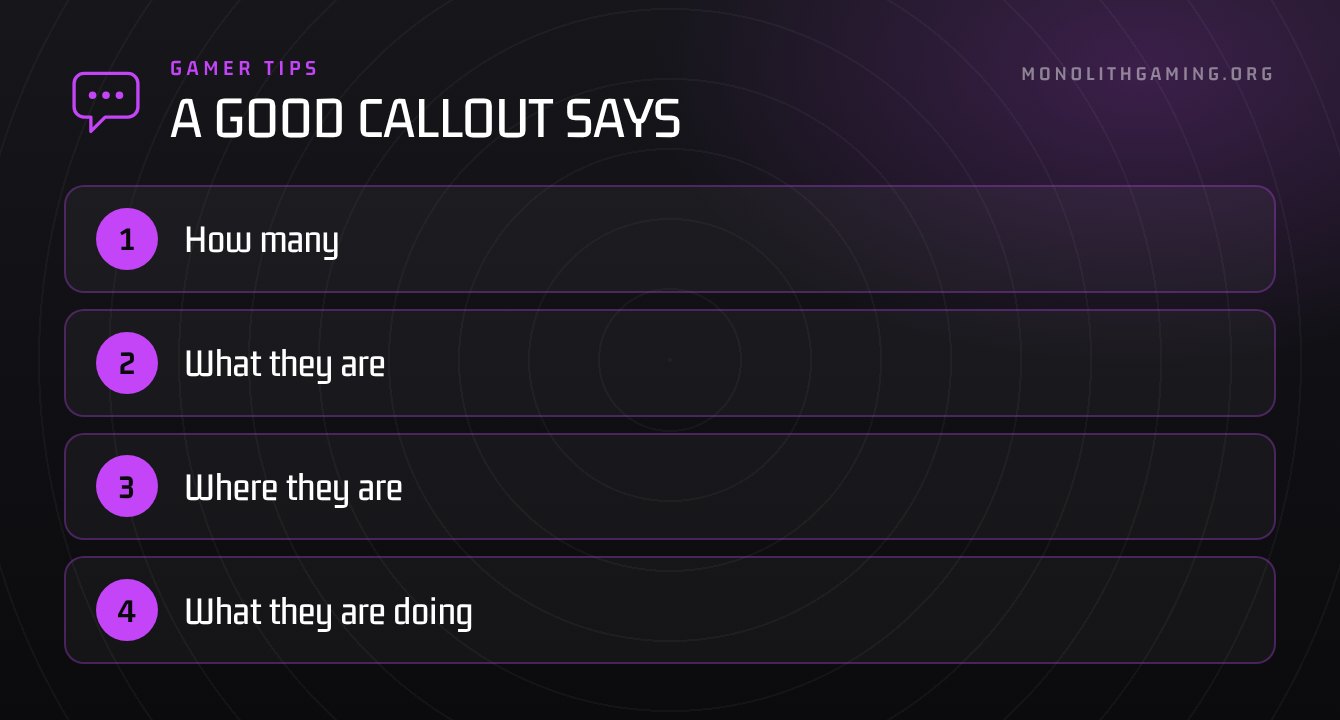
A complete callout answers three questions. “Two, pushing left stairs” tells your team everything. “They are over there” tells them nothing. If you only have part of the picture, give the part you have.
Rule 2: Keep it short
Aim for five words or fewer. People are playing while they listen. A long sentence arrives after the moment has passed.
Rule 3: Use names everyone knows
Agree on names for places. Most popular maps already have community names for each area. If your group does not know them, use simple descriptions such as “red building” or directions such as north and south. Pinging the spot in game works too.
“Information first, feelings after the round.”
Rule 4: Call it once, then stop
Repeat a callout only if something changes. When you are eliminated, give your last piece of information and then go quiet so the players still alive can hear the game.
Rule 5: Stay calm
Your tone carries as much as your words. A level voice keeps the team steady. Shouting makes people rush.
What to leave out
Skip the commentary on how you died, complaints about the other team and instructions to a teammate who is in the middle of a fight. Save feedback for between rounds, and keep it kind.
Practise it
Callouts are a habit. Try narrating what you see in a casual match, even when it feels unnecessary. After a few sessions it becomes automatic.
Examples of good callouts
Compare these pairs. “He’s one shot!” becomes “One, low health, behind blue car.” “They’re everywhere!” becomes “Three pushing main, I’m falling back.” “Help!” becomes “Need one on point, two here.” In each case the second version tells a teammate what to do next without them having to ask.
Callouts when you have no microphone
Not everyone can or wants to talk, and that is fine. Most modern games have a ping system that marks enemies, locations and items with a button press. A well-placed ping is often faster than speech. Quick-chat wheels cover the common messages. If you are leading a group, make it clear that pings count as callouts, so quieter players know their information is welcome.
The takeaway
Clear callouts are short, specific and calm. Say how many, what and where, then let your team play. Looking for people to practise with? The Squad Finder shows who is online in the Monolith Discord right now.